





20 Mark Prussia Wilhelm II Gold Coin

- Imperial era: German Empire
- Fine weight: 7.168 g of gold
- Safely encapsulated: in a coin capsule
- Imperial eraInscribed German Emperor, King of Prussia
- Fine weightA gold coin with a fineness of 900/1000
- Safely encapsulatedEach coin arrives protected in its own capsule







- Imperial era: German Empire
- Fine weight: 7.168 g of gold
- Safely encapsulated: in a coin capsule
 Price alert
 Share

Original from the German Empire · Wilhelm II
What a mark had to bear
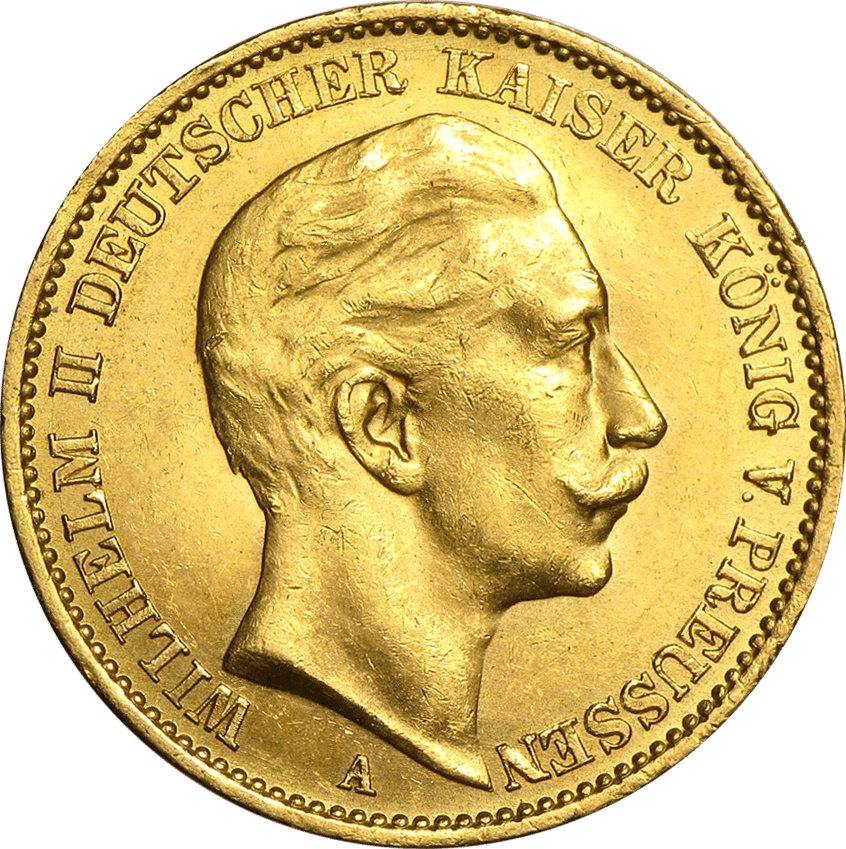
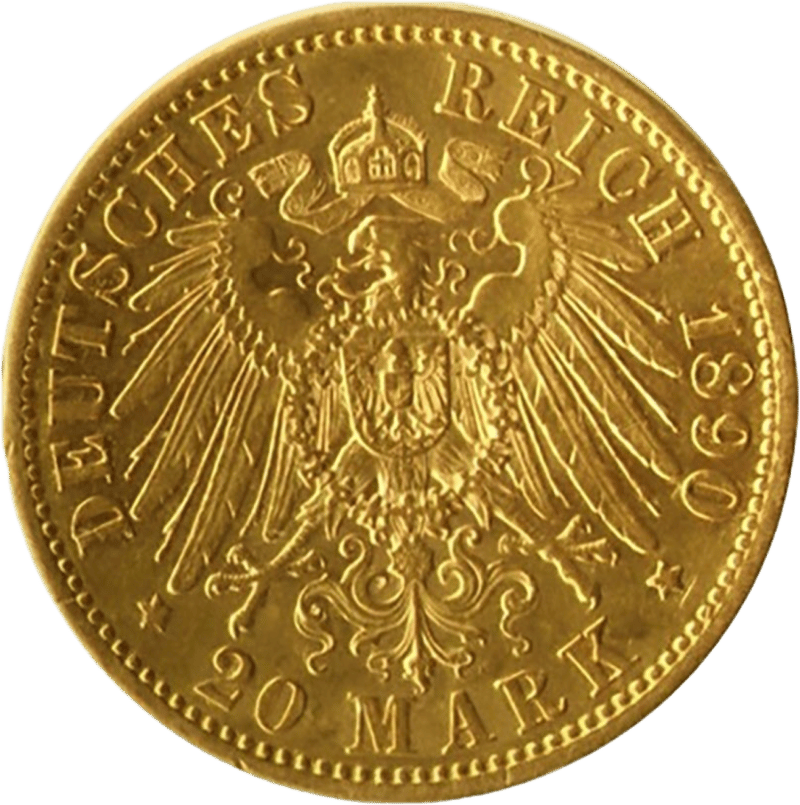
20 marks Prussia, Wilhelm II, obverse with the portrait
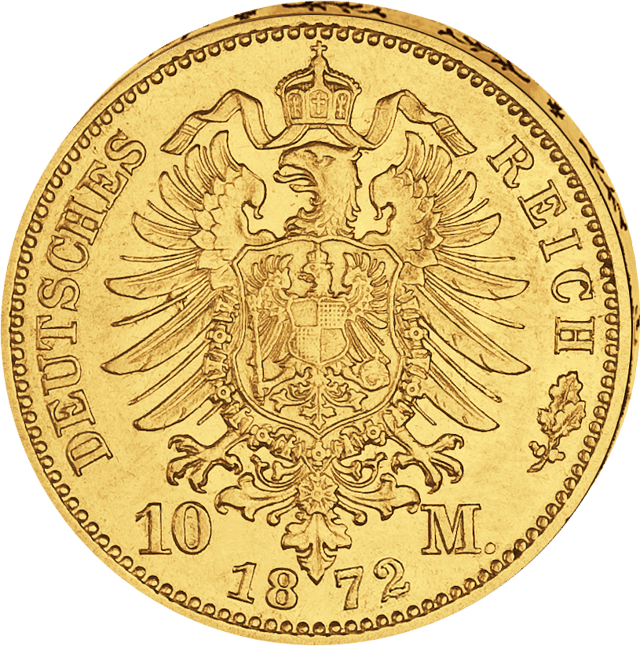
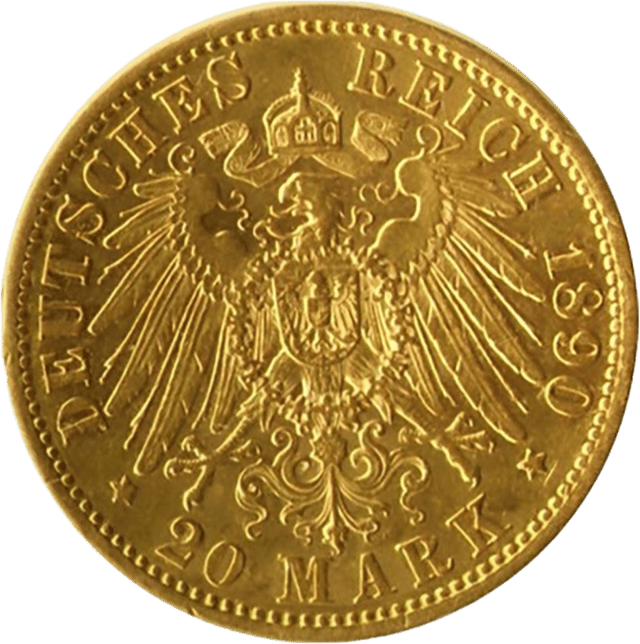
Value, year, imperial eagle and a letter for the mint: all of this was laid down by law. A piece of 20 marks weighs 7.96 g, of which 7.17 g is fine gold.
What the law prescribes
Eagle, value, year and a portrait
For every gold coin of the Reich, the law of 1871 laid down what it bears:
“The imperial gold coins bear on one side the imperial eagle with the inscription ‘Deutsches Reich’ and the statement of the value in marks, as well as the year of striking, on the other side the portrait of the sovereign, or the emblem of the free cities, with a corresponding legend and the mint mark.”
The Münzkabinett Berlin calls the side with the sovereign the obverse and the side with the eagle the reverse. The mint mark is the letter of the mint.
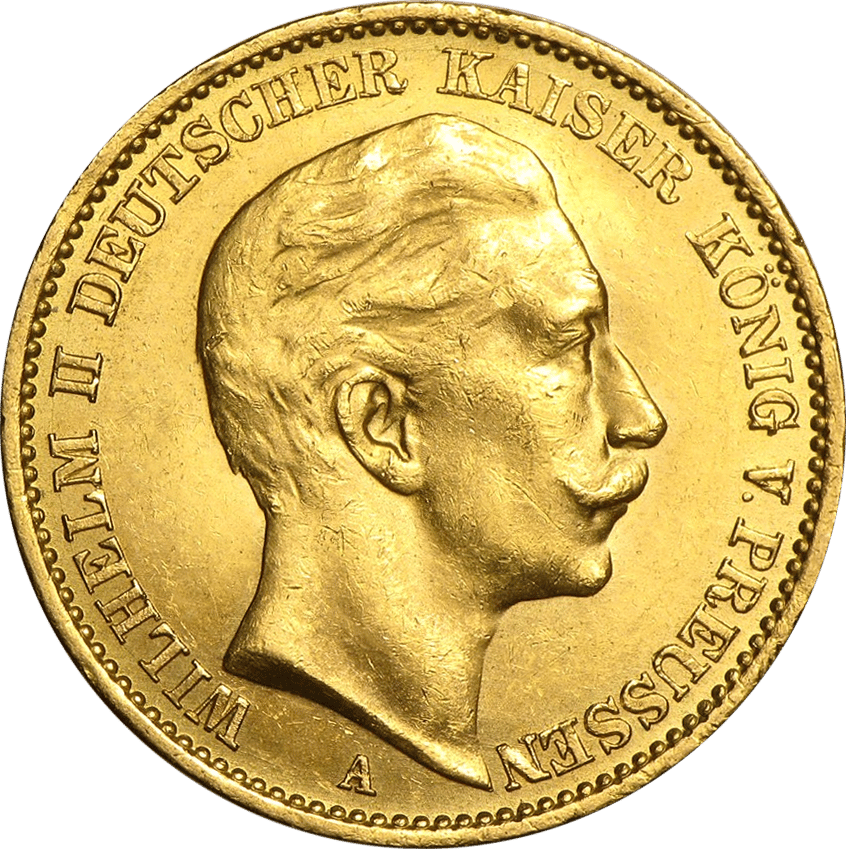
LegendThe legend above the portrait
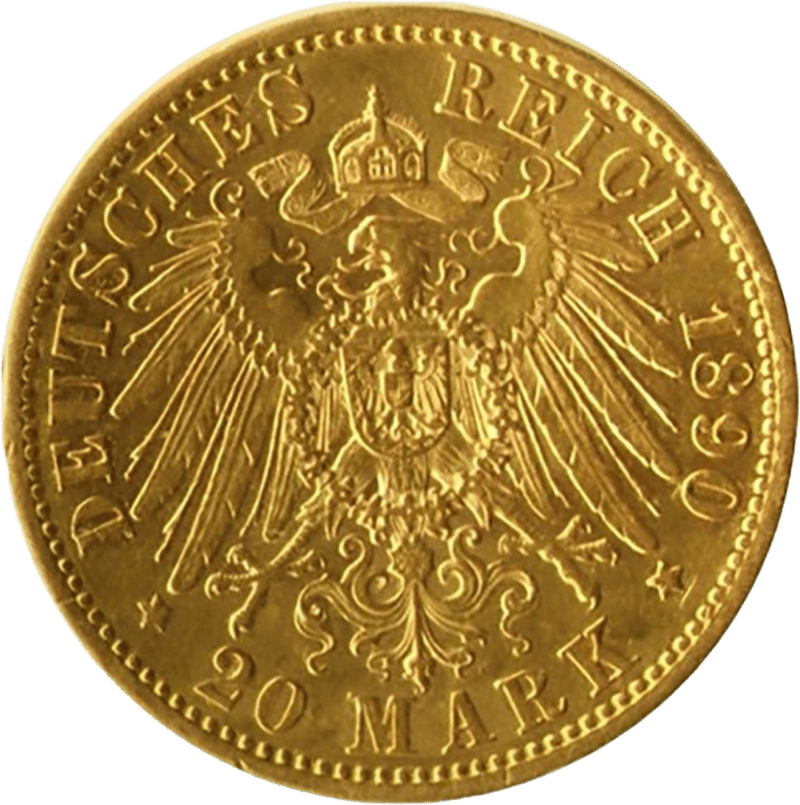
ReichThe word REICH above the eagle
ValueThe value below the eagle
The mint mark
A letter tells where it was struck
The law prescribes a mint mark for every gold coin: a letter that names the mint. A stands for Berlin, J for Hamburg, F for Stuttgart.
“Below, the mint mark J for Hamburg.”
The photo of this piece shows a A. As it comes from different years, your piece may bear another letter.

The gold of the mark
How heavy the gold had to be
The law of 1871 counted in pounds of fine gold, the pound at 500 grams:
“Imperial gold coins of 20 marks, of which 69¾ pieces are struck from one pound of fine gold.”
In other words: one pound of fine gold yields 69¾ pieces of 20 marks.
Fineness 900/1,000 means: of a thousand parts, nine hundred are pure gold.
Officially the ten-mark piece was called the crown and the twenty-mark piece the double crown, as a decree for the imperial authorities laid down in 1875. It never caught on, the Münzkabinett Berlin notes.
The mark in silver
The silver mark in the hand
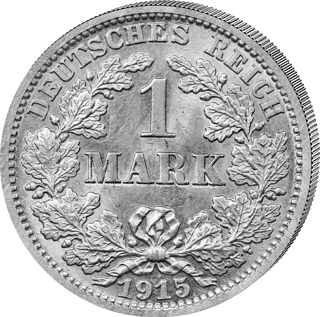
A mark holds 5 grams of fine silver, 900/1,000, and measures 24 millimetres. No one had to accept silver coins for amounts over 20 marks.
Commemorative coins
Thalers that commemorate
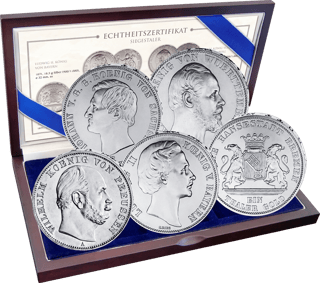
The Victory Thaler of 1871 from Prussia is a commemorative coin in silver. The law of 1871 allowed large silver coins for the time being only as commemorative coins, until the end of 1873.
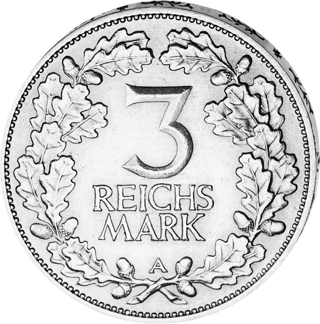
Rentenmark and Reichsmark
The Reichsmark from 1924
The coinage act of 30 August 1924 introduced the Reichsmark; in October 1924 it came into circulation alongside the Rentenmark, one to one.
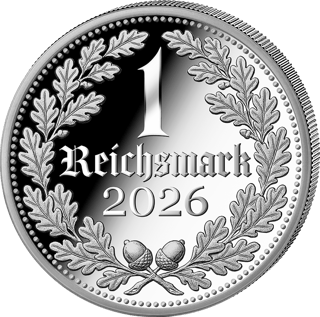
Our strikes
What our strikes take up
Our strikes bear the lettering 1 Reichsmark or 1 Mark in an oak wreath. They are newly struck, no Reichsmark of the past and no legal tender of the Reich.
At a glance
- Type
- Original
- Era
- German Empire
- Ruler
- Wilhelm II
- Face value
- 20 marks
- Metal
- Gold
- Fineness
- 900/1,000
- Gross weight
- 7.96 g
- Fine weight
- 7.17 g
- Diameter
- 22.5 mm
- Packaging
- Coin capsule
Gross weight: the weight of the whole coin. Fine weight: the pure metal in it. Fineness: its share in thousandths.
Details from our product data, the coinage acts and the photo. The year and mint mark of your piece may differ from the photo.

Original and new strike
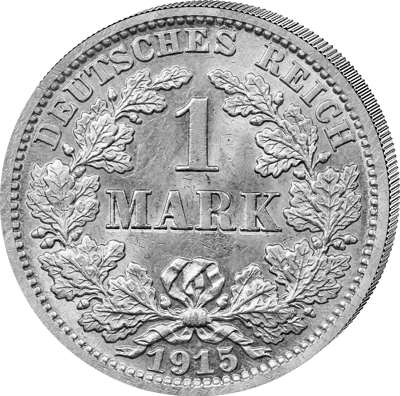
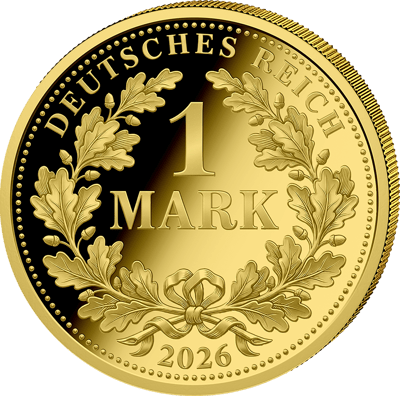
On the left a mark from the German Empire, on the right our strike of 1/200 ounce of fine gold, which takes up DEUTSCHES REICH and 1 MARK in an oak wreath.
One was money throughout the Reich, the other is newly struck: two pieces, one image.
20 Mark Prussia Wilhelm II Gold Coin: gold mark from the German Empire
- Motif: the portrait of Wilhelm II, framed by a legend that identifies him as German Emperor and King of Prussia.
- Material / fineness: gold alloy with a fineness of 900/1,000 and a fine gold content of 7.17 g.
- Manufacturer: the Berlin mint, which struck coins to the uniform standards of the Empire.
- Format: 22.50 mm in diameter, a size equally suited to a collection and to long-term provision.
- Condition: bank quality, as is typical for circulated coins of the German Empire.
Wilhelm II was German Emperor and King of Prussia from 1888 to 1918, the last monarch on both thrones. This coin dates from the era when the mark was based on gold and pieces like this one were an ordinary means of payment. Today they are among the classic German gold coins.
The mark of the German Empire and its gold content
After the founding of the Empire in 1871, the mark replaced the numerous currencies of the German states. The coinage law laid down the weight and fineness of every gold coin as binding, and identically for the whole Empire: a 20 mark coin always contains 7.17 g of fine gold. These coins circulated until the outbreak of the First World War in 1914, after which they disappeared from circulation. The currency only received the name gold mark in retrospect, to distinguish it from the paper money of the later inflation years.
A Prussian king as German Emperor
Wilhelm II ascended the throne in the so-called Year of the Three Emperors, after his father Frederick III had reigned for only 99 days. Prussia was the largest federal state of the Empire, and its king also bore the title of German Emperor. Many federal states struck their own gold coins with the portrait of their sovereign, whereas the denomination side with the imperial eagle, the inscription DEUTSCHES REICH and the face value had a uniform design. The legend DEUTSCHER KAISER KÖNIG V. PREUSSEN is clearly legible on the product photo. Details of the emperor's portrait differ depending on the year of minting.
What the inflation of the 1920s showed
In the early 1920s, Germany experienced an inflation in which paper money lost almost all of its purchasing power. Anyone who owned coins like this one at the time held a value in their hands that no printing press could dilute. Precisely therein lies the strength of gold as an inflation hedge to this day. With this coin, your crisis protection gains a building block whose gold content has outlasted every currency reform.
Condition, year of minting and taxes
More than a century lies between the minting of your coin and today. Small scratches or a slightly worn relief are normal for such a circulation coin, and the year of minting varies from piece to piece.
No VAT is levied on investment gold such as this coin from the imperial era. After more than one year in private ownership, a gain on sale is not subject to income tax in Germany.
What speaks for this gold coin
- Legacy of the Empire: You own an original piece from the reign of the last German Emperor.
- Uniform standard: Weight and fineness applied throughout the Empire, no matter in which federal state a 20 mark coin was made.
- Completed minting: Since the end of the monarchy in 1918, no new coins of this kind have been added.
- For collectors and investors: The coin fits into a collection of German Imperial coins just as well as into a provision portfolio.
- More than metal: Besides fine gold, every coin also contains Prussian and German history.
The imperial era is long gone, yet this coin has not lost a single gram of its weight.
Complete your holdings at Kettner Edelmetalle with the 20 Mark Prussia Wilhelm II Gold Coin, an original from the era of the gold mark.
Product depiction may differ from the final product.
