





- Ten condors: equal to 100 pesos
- Real history: from 1926 to 1980
- Fine weight: 18.3 g of gold
- Ten condorsThe condor was at times Chile's currency, worth 10 pesos
- Real historyIssued by Chile's central bank in the 20th century
- Fine weightFineness 900/1000, the rest is copper for extra hardness










- Ten condors: equal to 100 pesos
- Real history: from 1926 to 1980
- Fine weight: 18.3 g of gold
 Price alert
 Share
100 Chilean Peso Gold: the large full-value coin with the coat of arms of Chile
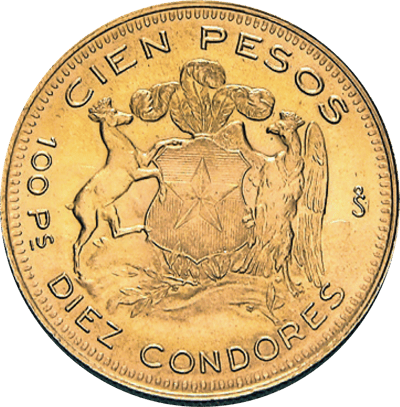
- Motif: the heraldic shield with the five-pointed star, held by an Andean condor and a huemul; three stylised feathers rise above the shield.
- Material / fineness: Gold with a fineness of 900/1,000; with a total weight of 20.34 g, that makes 18.3 g of fine gold.
- Coin type: Full-value coin whose face value was based on the value of the gold it contained.
- Manufacturer: the Chilean mint in Santiago de Chile.
- Condition: bank quality; as used circulation coins, each piece bears its own traces.
More than half a troy ounce of gold in a single coin: the 100 pesos coin is the heaviest denomination among the Chilean gold coins of this type. On its coat-of-arms side, two animals of the Andes meet, and the inscription states the coin's value twice. It thus combines plenty of fine gold with the history of Chile.
Condor and huemul on the coat of arms
CIEN PESOS (one hundred pesos) appears at the top of the rim, DIEZ CONDORES (ten condors) at the bottom. The second figure converts the value into cóndores, a unit of 10 pesos each that Chile used for a time. Between them, the coin shows the national coat of arms: a shield with a five-pointed star in the centre, held by two heraldic animals. One is the Andean condor, the other the huemul, a deer from the southern Andes. These two animals have supported the country's coat of arms since the 19th century. Both stand upright and turn towards the shield as if guarding it. Three stylised feathers rise above the shield.
What defines a full-value coin
The 100 pesos is a full-value coin. This is the term for coins whose stamped value was backed by the precious metal they contained: the face value stood for a fixed quantity of gold, in this case 18.3 g. Today's coins made of base metals are different; their value rests solely on what the state has decreed. Coins of this type were minted from 1926 onwards, initially as circulation coins, that is as a means of payment and not as commemorative issues. The stamped amount no longer plays any role today; all that matters is the gold contained in the coin.
Over half an ounce of fine gold for your protection
A troy ounce weighs 31.1 g, so with 18.3 g of fine gold the coin contains more than half of that. This makes it suitable for anyone who wants to build up noticeable gold value with just a few pieces. As a building block for your crisis protection, gold is convincing because it is traded all over the world and you can exchange it back into money if necessary. Gold has served as an inflation hedge for generations, because it preserves purchasing power over long periods.
The coin is in bank quality condition and may show traces of its past; which year of minting you receive is left to chance. As investment gold, it is VAT-free. If private investors in Germany hold the coin for more than one year, any gain on its sale is tax-free.
The 100 pesos at a glance
- Face value: 100 pesos, equal to ten cóndores
- Fine weight: 18.3 g
- Gross weight: 20.34 g
- Fineness: 900/1,000
- Manufacturer: Santiago de Chile
- Country of origin: Chile
- Condition: Bank quality
Two heraldic animals, two statements of value and 18.3 g of gold in one coin.
Choose the 100 Chilean Peso Gold from Kettner Edelmetalle and keep more than half an ounce of fine gold from Chile with it.
Product depiction may differ from the final product.
