





10 Dollar Liberty Head Gold
- Real history: Eagle since 1795
- Heraldic eagle: of the USA
- Fine weight: 15.04 g of gold
- Real historyOnce legal tender in the USA, issued by the US Mint
- Heraldic eagleBald eagle with shield, olive branch and arrows
- Fine weightA gold coin with a fineness of 900/1000










- Real history: Eagle since 1795
- Heraldic eagle: of the USA
- Fine weight: 15.04 g of gold
 Price alert
 Share
10 Dollar Liberty Head Gold: America's Eagle as a historic full-value coin
- Material / fineness: The coin weighs 16.71 g and, at a fineness of 900/1,000, contains a total of 15.04 g of fine gold.
- Manufacturer: The United States Mint has produced the coinage of the USA since the 18th century, including this Eagle.
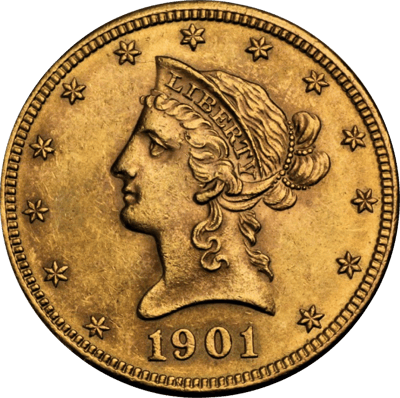
- Motif: the American heraldic eagle with breast shield, olive branch and three arrows, framed by the face value TEN D. and the country name UNITED STATES OF AMERICA.
- Full-value coin: genuine gold whose content once covered the value struck on the coin.
- Minting period: 1838 to 1907; the year of your coin cannot be chosen.
The United States called its 10-dollar coin the Eagle, and this name brought order to the whole system: alongside it there were the Quarter Eagle, the Half Eagle and the Double Eagle. The version with the portrait of Liberty remained in use for almost seven decades, making it one of the longest-used designs among American gold coins. Your coin was once a means of payment and today is a lasting tangible asset.
From the first Eagle to the Liberty Head
The US Mint issued the first Eagles in 1795, only a few years after it was founded. With the 1838 issue, the Eagle received the female head of Liberty, whose diadem bears the inscription LIBERTY. The product photo shows the reverse with the heraldic eagle, and fine reeding can be seen on the edge.
What makes a full-value coin
As a full-value coin, the Eagle was sized so that its gold content matched the value struck on it. The face value was therefore not just written on the coin, it was contained in its metal. Smaller coins made of base metals, by contrast, were token coins whose metal value lay well below their face value. The principle of the full-value coin makes historic gold coins so easy to understand: their value depends on the precious metal and not on a government's promise. With an Eagle you own exactly what has defined the coin from the very beginning: its gold.
A mid-sized format for your gold holdings
Between small gold coins and the heavy Double Eagle, the Eagle with 15.04 g of fine gold sits in the middle. This size suits you well if you want to build up your holdings step by step without handling too many individual pieces. Gold has proven itself again and again over long periods as an inflation hedge. What speaks for it as crisis protection is that gold exists independently of individual currencies and states.
Signs of circulation and a year from a long minting period
Bank quality means the coin was in circulation, and it may show it. Your coin is not selected by year; chance decides. That is precisely its appeal, because your piece may come from the early or the late years of this series.
Reasons for the 10-dollar Eagle
- Source of the name: The Eagle gave the American gold coin system its name.
- Proven standard: 900/1,000 was the usual fineness of American gold coins of that time.
- Known internationally: American gold coins from this era are a household name among investors and dealers worldwide.
- Free of VAT: The Eagle meets the criteria for investment gold.
- Tangible history: You own real money from the decades in which the USA grew into a major economic power.
Choose the 10 Dollar Liberty Head Gold as a solid building block for safeguarding your wealth at Kettner Edelmetalle.
Product depiction may differ from the final product.
